10 ways AI could *reduce* network data traffic
We really don't know what the net-effect will be. But we need to consider both angles.

Huge traffic volumes expected....
Nobody in the technology industry can ignore the huge impact that AI and datacentres are having on the networking sector, turbocharging the previous cloud-driven cycle. Huge requirements for connectivity between and inside datacentres are driving deployments of massive extra capacity, and development of new optical and photonic techniques to manage demand.
Inside DCs there’s huge interest in photonic switching and co-packaged optics between GPUs, which I wrote about last year. Over the wide area, we’re seeing ramp-ups in long-haul fibre backbones, subsea cable builds, metro fabrics and NaaS for scale-out expansion and local interconnect (see my Mplify Alliance event report here). Companies like Nokia Ciena Juniper Networks and others at the component / chipset & laser level are doing very well.
Inference and other classes of XPU, including at edge sites, change things again. At enterprise locations, faster Ethernet, private 5G cellular and Wi-Fi is increasingly linked to AI applications and vertical solutions such as machine vision or robotics / physical AI.
... but not yet on the access network
But the big unknown is the massmarket access network - fixed or mobile, especially for consumer smartphones, residential access, and other end-points such as vehicles and smart-home solutions.
Will continued GenAI deployment and use - and new AI paradigms such as agentics, edge-offload or robotics - move the needle for normal telco networks? Will it drive usage, congestion, investment - and perhaps extra regulatory focus or a need for more spectrum?
There is a lot of enthusiasm in the telecoms industry at the moment about AI driving future last-mile network traffic, and some of it is justified. Data volumes could certainly increase if we see more personalised video (and more consumption of it), more user-generated AI-enabled media, more cloud inference offload, more machine-to-machine interactions, perhaps agentic data (discussed later) and more uplink from cameras, robots, vehicles, drones, glasses, industrial systems and other forms of “physical AI”.
I wrote recently that uplink growth may be seen first in fixed broadband networks, earlier than mobile.
Traffic bull vs bear cases
In other words, there are perfectly plausible upside “bull” scenarios for access-network traffic. Various forecasts from Nokia Cisco, Ericsson and assorted fellow analysts and consultants have tried to quantify this. In some cases they have used existing observable data and tried to extrapolate. (My review of a recent Nokia study is here)
But whatever the source and growth methodology, that is only half the story.

Too many AI traffic forecasts start with a one-way assumption that “AI usage” automatically becomes a justification for more spectrum, edge infrastructure, slicing, new “kinetic tokens”, more QoS APIs, extra capex, or whatever else there is an interest in selling or regulating.
That chain of logic is partial and perhaps weak, because while AI will certainly change traffic patterns, and increase certain aspects, it may also reduce some types of traffic, shift traffic away from public access networks, compress it, filter it, delay it, localise it, or make networks more efficient at carrying it.
Moreover there are certain trends that we can see on the horizon - such as more on-device AI, or semantic compression - but which haven’t yet arrived. There could be disruptive innovations that lead to extra upside or downside.
So in the interest of balanced discussions, here are 10 reasons why AI might actually reduce network traffic, or at least reduce the need for additional public fixed or mobile access capacity. I’m still not sure on the net outcomes. But I am sure that any realistic analysis needs to consider both sets of drivers and argue convincingly for the balance of effects.
There is no guaranteed one-way ratchet effect here. Remember - voice minutes and SMS volumes kept growing... until they didn’t.
1. On-device inference reduces round trips to the cloud
The most obvious traffic-reduction mechanism is local inference. Phones, laptops, tablets, cars, cameras, home gateways, industrial controllers and AR glasses are all getting better AI-capable silicon, and while not all inference will be local, enough of it will be to matter.
Speech recognition, translation, image enhancement, summarisation, object detection, spam filtering, call screening, notification handling and many personal-assistant tasks can run partly or wholly on the device, rather than requiring every prompt, audio stream, image or sensor feed to be sent to a remote model.
In many cases, this will substitute for existing network traffic and cloud processing, not just minimise new AI loads.
This does not collapse all traffic, because models still need updates, some queries still require external knowledge and reasoning, some tasks need cloud-scale compute, and many applications will use hybrid local/cloud architectures. But it changes the traffic profile. In many cases, the network sees a much smaller transaction: a prompt, a command, a summary, a metadata or JSON object, an event, or nothing at all.
2. AI filters data before it reaches the network
A lot of future AI traffic claims rely on cameras, microphones and sensors sending huge amounts of upstream data, but the more realistic architecture is often the opposite: sensors generate huge raw data volumes locally, and AI decides what is actually worth transmitting.
A security camera does not need to upload 24 hours of empty corridor video if it can upload a short clip when it sees a person, a vehicle, smoke, or a suspect package. A factory vision system does not need to send every frame to a remote cloud if it can identify defects on-site, and a smart-city system does not need to stream every sensor reading if local analytics can classify, aggregate and discard the uninteresting bits.
This principle is not new. During an open day at CERN a few years ago, I remember seeing a rack of hardware discriminators (called triggers) for a particle-accelerator’s sensors, which acted to filter out 99% of useless readings from one of the main experiments in an underground chamber at the LHC.
AI filtering effectively changes the network from a raw-data conduit, to an exception-reporting system. The traffic reduction can be enormous, because most real-world sensor data is boring. AI’s job in many of these systems is not to archive everything, but to throw most of the potential traffic away before it ever hits the access network.
To be fair, there’s a fair amount of this type of pre-processing in existing systems already, without adding AI as well, but once again it should improve the ratio of both new and existing streams - as CERN itself now demonstrates, as it now has neural-network based triggers - see this post.
3. Semantic compression beats dumb compression
Traditional compression reduces the size of a file or stream, but AI enables something more radical: semantic compression. Instead of sending a video, a system might send “three people entered the room, one wearing a red jacket, no safety helmets detected”. Apart from botanists, nobody really needs every leaf on every tree in a movie scene to be rendered as its 4K original.
Instead of sending a full document, it might send the extracted fields. Instead of sending all Instead of sending a 30-minute meeting recording, it might send the transcript, decisions, action points and disputed items in a vCon record (as me how this fits with AI voice evolution) - and include a link to the raw audio if needed.
This will not apply everywhere, because sometimes people need the original image, clip, document or evidentiary record, and in regulated, safety-critical or legal settings the raw data may need to be retained. But even then, the access network may not need to transport all of it in real time, or transport it at all if local storage, local audit trails or delayed synchronisation are enough.
AI shifts the unit of communication from bytes to meaning, and that creates a major problem for simple traffic-growth extrapolations, because a lot of value can be delivered with fewer bits.
This also has huge implications if content can be semantically compressed on a server, sent across the network efficiently, and then reconstituted on the user device. (Or vice versa for uplinks)
4. Agents may replace browsing, not just add to it
Agentic AI is often presented as a traffic multiplier, with agents constantly fetching web pages, calling APIs, checking databases, negotiating with other agents and generating background activity at machine speed. There is a vision of agents running on your phone or laptop, which are continually going to the web to “do stuff”. Some of this probably comes from early experience of things like OpenClaw.
That may happen to excess, especially with badly-designed agents, repeated research tasks, web automation, testing systems, scraping-like behaviour or enterprise workflows that are allowed to run without proper cost controls. Some will legitimately create more traffic.
But agents can also replace a lot of human browsing or streaming, and in many cases they may retrieve less, not more. A human researching a holiday, insurance policy, phone tariff or medical condition might open dozens of pages, load images, adverts, trackers, recommendation widgets, autoplay videos, cookies, scripts and analytics, while scrolling through irrelevant material and abandoning most of it.
By contrast, a well-designed agent could query structured sources, use cached indexes, pull snippets, discard irrelevant material and return a concise answer. Much of the traffic will be “inside the cloud” as well, with a server-side agent connecting to its peers via IP interconnect and cloud backbones. The user may never load the original pages over the access network, and the agent may avoid much of the advertising and tracking overhead that makes the modern web so bloated.
This is a huge unknown. Some agents will be wasteful and noisy, while others will be brutally efficient. But it is far too simplistic to assume that every agentic workflow adds traffic on top of today’s web activity, because some of it will replace today’s messy, duplicated, media-heavy web activity with leaner machine-readable interactions. The current web is an inefficient traffic generator. AI may make it worse, but it may also route around some of the bloat.
5. AI work may happen inside “the cloud”, not across the last mile
The note in the previous section about agents driving inter-cloud traffic can be generalised.
A lot of other AI traffic will be real, but in the wrong place for many telecoms narratives. Training traffic is mostly inside data centres and between data centres. Large-scale inference may sit inside hyperscaler clouds. Enterprise AI may run in private cloud, SaaS platforms, corporate data centres, sovereign-cloud environments, campus infrastructure or sector-specific platforms. Agentic systems may perform most of their work near the data sources, with only the final output crossing the access network.
That still means more network demand, but not necessarily more public mobile or residential broadband demand. It may mean more 800G and 1.6T optical, more data-centre interconnect, more peering, more private fibre, more cloud-region connectivity, more traffic between GPUs, more east-west traffic and more enterprise WAN redesign and NaaS.
But those are not the same thing as “we need more macro-cellular spectrum”, upgrade to 10G-XGS-PON fibre, or “every cell site needs GPUs”.
This distinction matters because the telecoms industry - and their regulators and policymakers - often uses the word “network” as if all networks are the same. Maybe 80% of all attention from executives, investors, governments and commentators is on residential broadband or consumer 5G, as it’s what we all face day-to-day - and the retail market is huge, competitive and complex. But it’s not necessarily centre-stage for AI.
6. Scheduling and batching can move traffic out of the busy hour
Not all AI traffic is real-time, and so not all AI-related data needs to move immediately. From a network engineering standpoint, peak or busy-hour traffic matters much more than total aggregate traffic.
Model updates, training data, telemetry uploads, map updates, logs, synthetic data transfers, video archives, industrial analytics and fleet learning can often be delayed, batched, compressed or scheduled for times when capacity is cheap and plentiful.
A car can upload diagnostic data when parked at home, a robot can upload logs overnight, a phone can synchronise AI “memories” when charging on Wi-Fi, a camera system can upload evidence clips after local triage, and a home gateway can fetch model updates at 3am.
Again, this is not new or AI-specific, but the nature of AI itself means that (hopefully) optimisation of this sort of timing should improve. AI traffic forecasts therefore need to ask “when?” as well as “how much?”.
This is especially relevant for mobile spectrum arguments, where busy-hour, cell-level, location-specific demand is the real constraint. A large amount of off-peak AI-related data transfer does not create the same spectrum problem as live uplink from thousands of users in a dense urban cell or venue.
7. Better offload / federation will absorb a lot of AI traffic
Even where AI does increase access traffic to and from user devices, it will not all go over public mobile networks. Most AI usage on smartphones already happens indoors, on Wi-Fi, over fixed broadband.
We can reasonably expect AI-enabled connection management tools or OS functions to improve this ratio, especially if coupled with wider adoption of automated access via approaches such as Passpoint and OpenRoaming.
Many enterprise AI systems will use Ethernet, Wi-Fi 7, private fibre, local 5G, industrial wireless or on-premises compute. Physical AI in factories, ports, warehouses, hospitals, universities, airports and campuses is much more likely to use local connectivity than national macro networks.
Various mobile AI use cases will still need wide-area cellular, of course. Vehicles, logistics, field workers, consumer mobility, outdoor robotics and remote monitoring are obvious candidates for these types of application generating traffic.
But the centre of gravity for heavy AI traffic is likely to be indoors, fixed, local, private or cloud-adjacent. That is why I remain skeptical of “AI therefore mobile spectrum” arguments in particular.
To be fair, AI prove to be may be an argument for better Wi-Fi, private networks and cellular neutral hosts, as I’ll be discussing in my July 16th workshop on Indoor Wireless (details and sign-up here). But that’s not so much about data volumes as reliability, latency, sovereignty and security.
8. AI can improve network efficiency or change user behaviour
AI is not just a traffic source. It is also a network optimisation tool.
I’m about to head off to DTW in Copenhagen this week, and I’m sure I’ll be saturated with details of operators and vendors already using AI and machine learning. It has applicability for traffic prediction, energy management, RAN parameter optimisation, fault detection, routing, anomaly detection, customer experience management, capacity planning and spectrum efficiency.
That doesn’t all necessarily reduce traffic, although some forms of network management and demand-shaping will indeed have that effect. And while some of this will be overhyped, or just turn out to be old optimisation techniques with an AI sticker, the direction is real.
If AI helps networks carry more traffic with the same spectrum, same fibre, same routers or same number of sites, then the pressure for additional capacity is lower than a simple demand forecast suggests. This is especially important for mobile, because if traffic growth slows while efficiency increases, then the investment story looks very different - with possible overcapacity risk, as I have written before.
9. Personalisation can reduce wasted media consumption
A lot of today’s bulk consumer data traffic is recommendation-driven waste: autoplay videos, infinite scroll, poorly-targeted adverts, oversized images, preloaded content never viewed or listened to, duplicate downloads and pages stuffed with scripts, trackers, cookies and other undesirable nonsense.
Uploads are equally bloated - why do we back up the 5 lousy video takes or blurry/badly framed images, as well as the nice one we actually want?
AI could certainly make all of this much worse, or much better. One one hand, we could suffer from it generating endless personalised slop, spam video adverts and addictive scrolling.
But it could also make content discovery or sharing more efficient.
A good AI assistant might say: “You do not need to watch these five videos or listen to hours of podcasts. Here are the three points you care about, and here are the clipped highlights compiled”.
I’ve long wanted to have a tool that can, say, watch or listen to all the recent telco results webcasts and answer queries like “give me the bits where they talk about spectrum”. I don’t need the sections where the CFO talks about pensions, or where some sycophantic financial analyst congratulates them on a “great quarter, guys”.
Going further, such a tool might block low-quality content - imagine a personalised “avoid boring waffle” filter!
Now obviously the advertising industry will fight hard to preserve wasteful engagement loops, and content creators might balk at brutal editing. But the downside scenario exists. Any serious traffic forecast needs to model the possibility that AI reduces some categories of human attention-driven traffic, even while increasing others
10. Economic constraints will discipline AI traffic
AI usage and traffic is not just technology. It is economics. Cloud inference, GPU time, energy, API calls and mobile uplink all cost money. Enterprises will not allow uncontrolled agent usage to generate unlimited traffic, and there will likely be consumer protections too.
The first wave of AI usage has been distorted by free tiers, investor subsidies, ludicrous concepts like “tokenmaxxing” and novelty. We already see the push-back on this.
As AI gets priced properly, applications and infrastructure will become more efficient. They will use better model-routing, cache more, compress more, summarise more, use smaller models, run locally, batch requests, and avoid shipping around unnecessary context and data.
This economic imperative will translate to data traffic as well. The idea that AI agents will run everywhere, all the time, generating unlimited public-network broadband and mobile traffic, is not a forecast. It is a cartoon.
Conclusions
I am not saying AI will reduce network traffic consistently or ubiquitously. It clearly will not. AI will increase some traffic, in some places, at some times, over some networks, and it will drive a lot of investment especially in datacentres, fibre routes, interconnect, NaaS and elsewhere.
It may also increase some fixed access traffic and some mobile uplink traffic, especially for video-heavy, sensor-heavy, physical-AI and enterprise applications. But that is not the whole story.
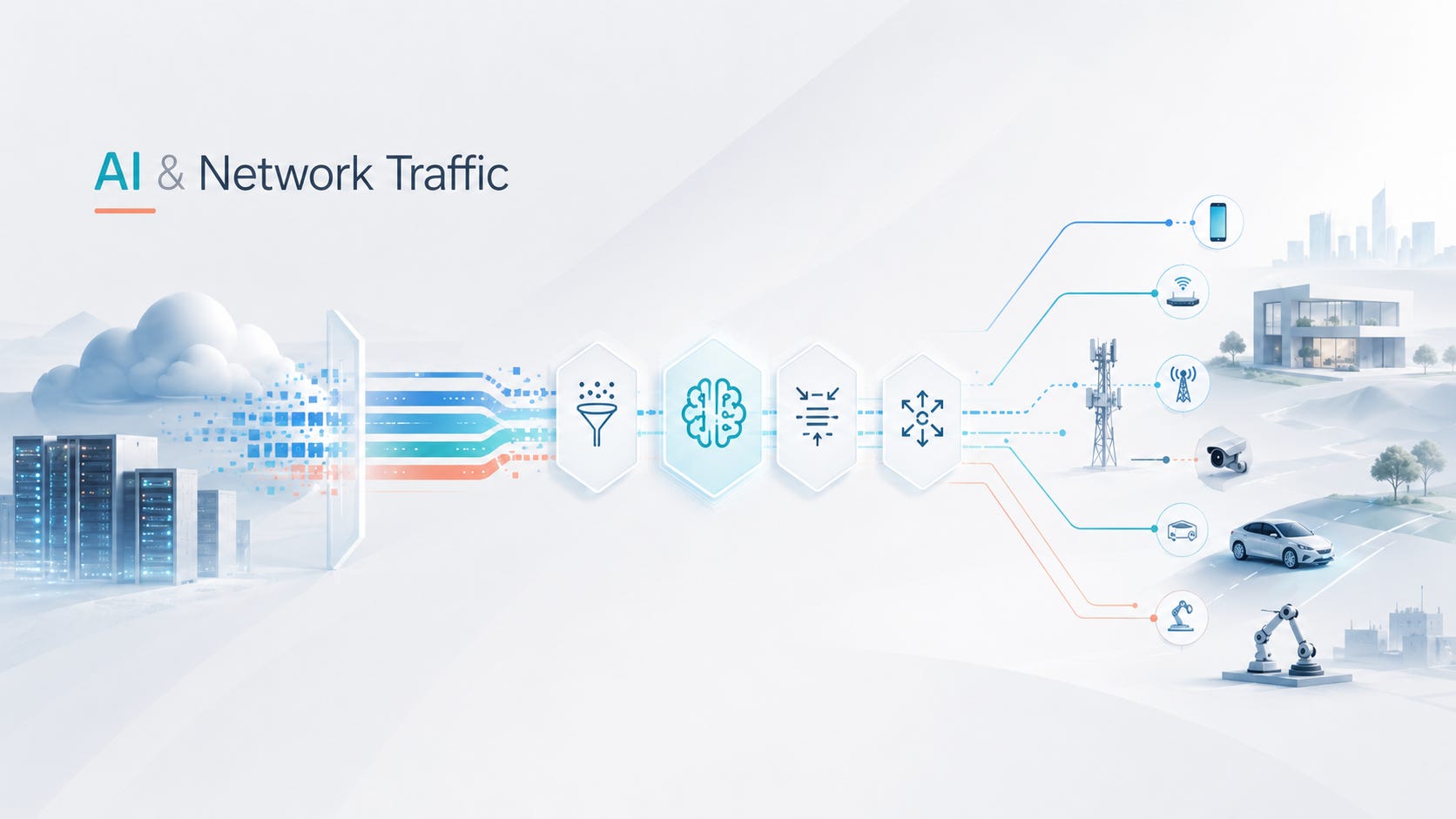
AI could reduce access traffic through local inference, semantic compression, filtering, scheduling, offload and application / behaviour change. It makes everything more unpredictable as there will be a dynamic mix of increase/decrease drivers and dependencies.
The net-net is hard to gauge - and it seems to me most people don’t bother to try. They mostly just focus on the bull case, for obvious reasons. But modelling the upside while ignoring the downside or relegating it to a footnote or sidebar is not enough.
The unanswered question is not simply “will AI increase traffic?”, but where, which network, which direction, at what time of day, on whose infrastructure, at what cost, with what substitution, and with what impact on public fixed or mobile access networks.
Operators and policymakers faced with AI network forecasts need to ask questions about whether both sides of the ledger have been considered equally.
If not, they should consider why that might be, and react accordingly.
This post was originally published on my LinkedIn newsletter. See LI for more comments and responses.
hotonic techniques to manage demand.
Inside DCs there’s huge interest in photonic switching and co-packaged optics between GPUs, which I wrote about last year. Over the wide area, we’re seeing ramp-ups in long-haul fibre backbones, subsea cable builds, metro fabrics and NaaS for scale-out expansion and local interconnect (see my Mplify Alliance event report here). Companies like Nokia Ciena Juniper Networks and others at the component / chipset & laser level are doing very well.
Inference and other classes of XPU, including at edge sites, change things again. At enterprise locations, faster Ethernet, private 5G cellular and Wi-Fi is increasingly linked to AI applications and vertical solutions such as machine vision or robotics / physical AI.
... but not yet on the access network
But the big unknown is the massmarket access network - fixed or mobile, especially for consumer smartphones, residential access, and other end-points such as vehicles and smart-home solutions.
Will continued GenAI deployment and use - and new AI paradigms such as agentics, edge-offload or robotics - move the needle for normal telco networks? Will it drive usage, congestion, investment - and perhaps extra regulatory focus or a need for more spectrum?
There is a lot of enthusiasm in the telecoms industry at the moment about AI driving future last-mile network traffic, and some of it is justified. Data volumes could certainly increase if we see more personalised video (and more consumption of it), more user-generated AI-enabled media, more cloud inference offload, more machine-to-machine interactions, perhaps agentic data (discussed later) and more uplink from cameras, robots, vehicles, drones, glasses, industrial systems and other forms of “physical AI”.
I wrote recently that uplink growth may be seen first in fixed broadband networks, earlier than mobile.
Traffic bull vs bear cases
In other words, there are perfectly plausible upside “bull” scenarios for access-network traffic. Various forecasts from Nokia Cisco, Ericsson and assorted fellow analysts and consultants have tried to quantify this. In some cases they have used existing observable data and tried to extrapolate. (My review of a recent Nokia study is here)
But whatever the source and growth methodology, that is only half the story.
Too many AI traffic forecasts start with a one-way assumption that “AI usage” automatically becomes a justification for more spectrum, edge infrastructure, slicing, new “kinetic tokens”, more QoS APIs, extra capex, or whatever else there is an interest in selling or regulating.
That chain of logic is partial and perhaps weak, because while AI will certainly change traffic patterns, and increase certain aspects, it may also reduce some types of traffic, shift traffic away from public access networks, compress it, filter it, delay it, localise it, or make networks more efficient at carrying it.
Moreover there are certain trends that we can see on the horizon - such as more on-device AI, or semantic compression - but which haven’t yet arrived. There could be disruptive innovations that lead to extra upside or downside.
So in the interest of balanced discussions, here are 10 reasons why AI might actually reduce network traffic, or at least reduce the need for additional public fixed or mobile access capacity. I’m still not sure on the net outcomes. But I am sure that any realistic analysis needs to consider both sets of drivers and argue convincingly for the balance of effects.
There is no guaranteed one-way ratchet effect here. Remember - voice minutes and SMS volumes kept growing... until they didn’t.
1. On-device inference reduces round trips to the cloud
The most obvious traffic-reduction mechanism is local inference. Phones, laptops, tablets, cars, cameras, home gateways, industrial controllers and AR glasses are all getting better AI-capable silicon, and while not all inference will be local, enough of it will be to matter.
Speech recognition, translation, image enhancement, summarisation, object detection, spam filtering, call screening, notification handling and many personal-assistant tasks can run partly or wholly on the device, rather than requiring every prompt, audio stream, image or sensor feed to be sent to a remote model.
In many cases, this will substitute for existing network traffic and cloud processing, not just minimise new AI loads.
This does not collapse all traffic, because models still need updates, some queries still require external knowledge and reasoning, some tasks need cloud-scale compute, and many applications will use hybrid local/cloud architectures. But it changes the traffic profile. In many cases, the network sees a much smaller transaction: a prompt, a command, a summary, a metadata or JSON object, an event, or nothing at all.
2. AI filters data before it reaches the network
A lot of future AI traffic claims rely on cameras, microphones and sensors sending huge amounts of upstream data, but the more realistic architecture is often the opposite: sensors generate huge raw data volumes locally, and AI decides what is actually worth transmitting.
A security camera does not need to upload 24 hours of empty corridor video if it can upload a short clip when it sees a person, a vehicle, smoke, or a suspect package. A factory vision system does not need to send every frame to a remote cloud if it can identify defects on-site, and a smart-city system does not need to stream every sensor reading if local analytics can classify, aggregate and discard the uninteresting bits.
This principle is not new. During an open day at CERN a few years ago, I remember seeing a rack of hardware discriminators (called triggers) for a particle-accelerator’s sensors, which acted to filter out 99% of useless readings from one of the main experiments in an underground chamber at the LHC.
AI filtering effectively changes the network from a raw-data conduit, to an exception-reporting system. The traffic reduction can be enormous, because most real-world sensor data is boring. AI’s job in many of these systems is not to archive everything, but to throw most of the potential traffic away before it ever hits the access network.
To be fair, there’s a fair amount of this type of pre-processing in existing systems already, without adding AI as well, but once again it should improve the ratio of both new and existing streams - as CERN itself now demonstrates, as it now has neural-network based triggers - see this post.
3. Semantic compression beats dumb compression
Traditional compression reduces the size of a file or stream, but AI enables something more radical: semantic compression. Instead of sending a video, a system might send “three people entered the room, one wearing a red jacket, no safety helmets detected”. Apart from botanists, nobody really needs every leaf on every tree in a movie scene to be rendered as its 4K original.
Instead of sending a full document, it might send the extracted fields. Instead of sending all Instead of sending a 30-minute meeting recording, it might send the transcript, decisions, action points and disputed items in a vCon record (as me how this fits with AI voice evolution) - and include a link to the raw audio if needed.
This will not apply everywhere, because sometimes people need the original image, clip, document or evidentiary record, and in regulated, safety-critical or legal settings the raw data may need to be retained. But even then, the access network may not need to transport all of it in real time, or transport it at all if local storage, local audit trails or delayed synchronisation are enough.
AI shifts the unit of communication from bytes to meaning, and that creates a major problem for simple traffic-growth extrapolations, because a lot of value can be delivered with fewer bits.
This also has huge implications if content can be semantically compressed on a server, sent across the network efficiently, and then reconstituted on the user device. (Or vice versa for uplinks)
4. Agents may replace browsing, not just add to it
Agentic AI is often presented as a traffic multiplier, with agents constantly fetching web pages, calling APIs, checking databases, negotiating with other agents and generating background activity at machine speed. There is a vision of agents running on your phone or laptop, which are continually going to the web to “do stuff”. Some of this probably comes from early experience of things like OpenClaw.
That may happen to excess, especially with badly-designed agents, repeated research tasks, web automation, testing systems, scraping-like behaviour or enterprise workflows that are allowed to run without proper cost controls. Some will legitimately create more traffic.
But agents can also replace a lot of human browsing or streaming, and in many cases they may retrieve less, not more. A human researching a holiday, insurance policy, phone tariff or medical condition might open dozens of pages, load images, adverts, trackers, recommendation widgets, autoplay videos, cookies, scripts and analytics, while scrolling through irrelevant material and abandoning most of it.
By contrast, a well-designed agent could query structured sources, use cached indexes, pull snippets, discard irrelevant material and return a concise answer. Much of the traffic will be “inside the cloud” as well, with a server-side agent connecting to its peers via IP interconnect and cloud backbones. The user may never load the original pages over the access network, and the agent may avoid much of the advertising and tracking overhead that makes the modern web so bloated.
This is a huge unknown. Some agents will be wasteful and noisy, while others will be brutally efficient. But it is far too simplistic to assume that every agentic workflow adds traffic on top of today’s web activity, because some of it will replace today’s messy, duplicated, media-heavy web activity with leaner machine-readable interactions. The current web is an inefficient traffic generator. AI may make it worse, but it may also route around some of the bloat.
5. AI work may happen inside “the cloud”, not across the last mile
The note in the previous section about agents driving inter-cloud traffic can be generalised.
A lot of other AI traffic will be real, but in the wrong place for many telecoms narratives. Training traffic is mostly inside data centres and between data centres. Large-scale inference may sit inside hyperscaler clouds. Enterprise AI may run in private cloud, SaaS platforms, corporate data centres, sovereign-cloud environments, campus infrastructure or sector-specific platforms. Agentic systems may perform most of their work near the data sources, with only the final output crossing the access network.
That still means more network demand, but not necessarily more public mobile or residential broadband demand. It may mean more 800G and 1.6T optical, more data-centre interconnect, more peering, more private fibre, more cloud-region connectivity, more traffic between GPUs, more east-west traffic and more enterprise WAN redesign and NaaS.
But those are not the same thing as “we need more macro-cellular spectrum”, upgrade to 10G-XGS-PON fibre, or “every cell site needs GPUs”.
This distinction matters because the telecoms industry - and their regulators and policymakers - often uses the word “network” as if all networks are the same. Maybe 80% of all attention from executives, investors, governments and commentators is on residential broadband or consumer 5G, as it’s what we all face day-to-day - and the retail market is huge, competitive and complex. But it’s not necessarily centre-stage for AI.
6. Scheduling and batching can move traffic out of the busy hour
Not all AI traffic is real-time, and so not all AI-related data needs to move immediately. From a network engineering standpoint, peak or busy-hour traffic matters much more than total aggregate traffic.
Model updates, training data, telemetry uploads, map updates, logs, synthetic data transfers, video archives, industrial analytics and fleet learning can often be delayed, batched, compressed or scheduled for times when capacity is cheap and plentiful.
A car can upload diagnostic data when parked at home, a robot can upload logs overnight, a phone can synchronise AI “memories” when charging on Wi-Fi, a camera system can upload evidence clips after local triage, and a home gateway can fetch model updates at 3am.
Again, this is not new or AI-specific, but the nature of AI itself means that (hopefully) optimisation of this sort of timing should improve. AI traffic forecasts therefore need to ask “when?” as well as “how much?”.
This is especially relevant for mobile spectrum arguments, where busy-hour, cell-level, location-specific demand is the real constraint. A large amount of off-peak AI-related data transfer does not create the same spectrum problem as live uplink from thousands of users in a dense urban cell or venue.
7. Better offload / federation will absorb a lot of AI traffic
Even where AI does increase access traffic to and from user devices, it will not all go over public mobile networks. Most AI usage on smartphones already happens indoors, on Wi-Fi, over fixed broadband.
We can reasonably expect AI-enabled connection management tools or OS functions to improve this ratio, especially if coupled with wider adoption of automated access via approaches such as Passpoint and OpenRoaming.
Many enterprise AI systems will use Ethernet, Wi-Fi 7, private fibre, local 5G, industrial wireless or on-premises compute. Physical AI in factories, ports, warehouses, hospitals, universities, airports and campuses is much more likely to use local connectivity than national macro networks.
Various mobile AI use cases will still need wide-area cellular, of course. Vehicles, logistics, field workers, consumer mobility, outdoor robotics and remote monitoring are obvious candidates for these types of application generating traffic.
But the centre of gravity for heavy AI traffic is likely to be indoors, fixed, local, private or cloud-adjacent. That is why I remain skeptical of “AI therefore mobile spectrum” arguments in particular.
To be fair, AI prove to be may be an argument for better Wi-Fi, private networks and cellular neutral hosts, as I’ll be discussing in my July 16th workshop on Indoor Wireless (details and sign-up here). But that’s not so much about data volumes as reliability, latency, sovereignty and security.
8. AI can improve network efficiency or change user behaviour
AI is not just a traffic source. It is also a network optimisation tool.
I’m about to head off to DTW in Copenhagen this week, and I’m sure I’ll be saturated with details of operators and vendors already using AI and machine learning. It has applicability for traffic prediction, energy management, RAN parameter optimisation, fault detection, routing, anomaly detection, customer experience management, capacity planning and spectrum efficiency.
That doesn’t all necessarily reduce traffic, although some forms of network management and demand-shaping will indeed have that effect. And while some of this will be overhyped, or just turn out to be old optimisation techniques with an AI sticker, the direction is real.
If AI helps networks carry more traffic with the same spectrum, same fibre, same routers or same number of sites, then the pressure for additional capacity is lower than a simple demand forecast suggests. This is especially important for mobile, because if traffic growth slows while efficiency increases, then the investment story looks very different - with possible overcapacity risk, as I have written before.
9. Personalisation can reduce wasted media consumption
A lot of today’s bulk consumer data traffic is recommendation-driven waste: autoplay videos, infinite scroll, poorly-targeted adverts, oversized images, preloaded content never viewed or listened to, duplicate downloads and pages stuffed with scripts, trackers, cookies and other undesirable nonsense.
Uploads are equally bloated - why do we back up the 5 lousy video takes or blurry/badly framed images, as well as the nice one we actually want?
AI could certainly make all of this much worse, or much better. One one hand, we could suffer from it generating endless personalised slop, spam video adverts and addictive scrolling.
But it could also make content discovery or sharing more efficient.
A good AI assistant might say: “You do not need to watch these five videos or listen to hours of podcasts. Here are the three points you care about, and here are the clipped highlights compiled”.
I’ve long wanted to have a tool that can, say, watch or listen to all the recent telco results webcasts and answer queries like “give me the bits where they talk about spectrum”. I don’t need the sections where the CFO talks about pensions, or where some sycophantic financial analyst congratulates them on a “great quarter, guys”.
Going further, such a tool might block low-quality content - imagine a personalised “avoid boring waffle” filter!
Now obviously the advertising industry will fight hard to preserve wasteful engagement loops, and content creators might balk at brutal editing. But the downside scenario exists. Any serious traffic forecast needs to model the possibility that AI reduces some categories of human attention-driven traffic, even while increasing others
10. Economic constraints will discipline AI traffic
AI usage and traffic is not just technology. It is economics. Cloud inference, GPU time, energy, API calls and mobile uplink all cost money. Enterprises will not allow uncontrolled agent usage to generate unlimited traffic, and there will likely be consumer protections too.
The first wave of AI usage has been distorted by free tiers, investor subsidies, ludicrous concepts like “tokenmaxxing” and novelty. We already see the push-back on this.
As AI gets priced properly, applications and infrastructure will become more efficient. They will use better model-routing, cache more, compress more, summarise more, use smaller models, run locally, batch requests, and avoid shipping around unnecessary context and data.
This economic imperative will translate to data traffic as well. The idea that AI agents will run everywhere, all the time, generating unlimited public-network broadband and mobile traffic, is not a forecast. It is a cartoon.
Conclusions
I am not saying AI will reduce network traffic consistently or ubiquitously. It clearly will not. AI will increase some traffic, in some places, at some times, over some networks, and it will drive a lot of investment especially in datacentres, fibre routes, interconnect, NaaS and elsewhere.
It may also increase some fixed access traffic and some mobile uplink traffic, especially for video-heavy, sensor-heavy, physical-AI and enterprise applications. But that is not the whole story.
AI could reduce access traffic through local inference, semantic compression, filtering, scheduling, offload and application / behaviour change. It makes everything more unpredictable as there will be a dynamic mix of increase/decrease drivers and dependencies.
The net-net is hard to gauge - and it seems to me most people don’t bother to try. They mostly just focus on the bull case, for obvious reasons. But modelling the upside while ignoring the downside or relegating it to a footnote or sidebar is not enough.
The unanswered question is not simply “will AI increase traffic?”, but where, which network, which direction, at what time of day, on whose infrastructure, at what cost, with what substitution, and with what impact on public fixed or mobile access networks.
Operators and policymakers faced with AI network forecasts need to ask questions about whether both sides of the ledger have been considered equally.
If not, they should consider why that might be, and react accordingly.
This post was originally published on my LinkedIn newsletter. See LI for more comments and responses.