Review: Nokia Global Network Traffic Report
Some interesting angles - but it's missing a "bear case" and lot of intra-cloud data

At the end of 2025, Nokia put out a new edition of its Global Network Traffic report, which it subtitles “Understanding the growing impact of advancing technologies on future networks” - primarily around the effect of AI on traffic patterns.
It’s in the same class of documents as Ericsson’s regular series of Mobility Reports, and a wide variety of “State of XXX” (cloud, Internet, AI, etc) from other vendors and service providers. The better ones - like Nokia’s and Ericsson’s - have dedicated research terms or lean on their internal consultancy arms.
Normally these are aimed at a wide variety of readers, from strategists at telcos, to investors, policymakers, analysts and other stakeholder groups. The more statistical ones, such as this, also get used as inputs and references by many other reports, so there’s often an indirect effect on things like broadband and spectrum policy, as they get used in justifications for spectrum or regulatory interventions.
It’s fair to say that while they are analytical and well-written, they sometimes tend to err on the “glass half-full” side of pure objectivity. After all, if an industry’s outlook - or its fundamental drivers - isn’t great, then no company’s marketing or comms department is going to fund a widely-circulated report documenting the issues.
What’s good about the report?
I’d say that the Nokia network traffic report is a pretty good example of the genre. It’s written as a landscape-format PDF, with plenty of charts and a few detailed footnotes. It has clearly had input from a wide variety of sector experts and covers ground from agentic AI, to compression algorithms and video codecs, to enterprise and industrial use-cases.
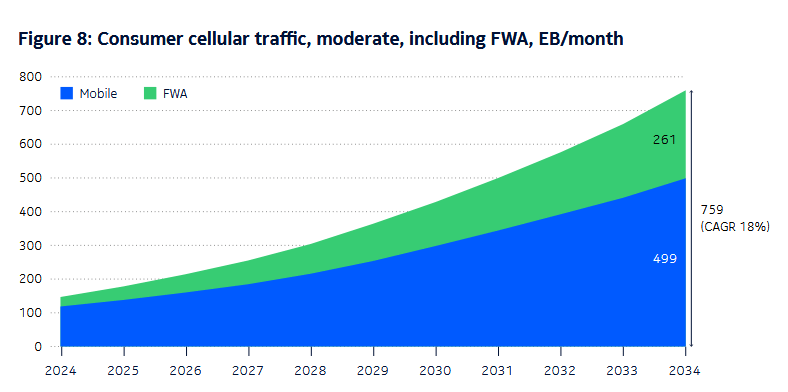
I like the fact it has distinct scenarios (conservative vs. moderate vs. aggressive) and also looks at global regional trends, as trends observed in Europe or the US may be very different in China or LatAm. Breaking out FWA from MBB mobile traffic is also a good practice, which should be adopted more widely by market observers, as FWA traffic is about 20-30x higher per-subscriber and significantly skews overall numbers.
I like the segmentation between direct and indirect AI-led traffic changes, although as I note below I’m not 100% convinced by the indirect uplift estimates.
The report also has a few counterpoints to the “traffic tsunami” hype. It’s good to see recognition that codecs and compression are improving, that AR/VR hasn’t lived up to early expectations for adoption, and that a fair amount of AI inferencing will be on-device rather than needing constant roundtrips to the network or edge nodes.
It has a methodology page, although it’s not really detailed, although it gives a decent set of definitions of what is and isn’t covered. It states it covers “traffic that traverses service provider and enterprise wide-area network (WAN) infrastructure, including public internet, managed and private WAN services, and movement between data centers”, although I’m somewhat skeptical of that last point; a lot of inter-DC traffic runs over dark or private fibre - and everything I hear suggests that it can be many multiples of traffic on access (last mile) connections to end-users.
I also like the observation about “multi-modal experiences” which the report notes are “blending video, voice, gaming and real-time interaction, driving tighter expectations for latency and jitter. Networks are being pushed not just to deliver more data, but to deliver it predictably”. That could be interpreted as a call either for more granular and deterministic QoS, or perhaps in-network techniques like L4S to manage latency, although it doesn’t go into detail.
The problems
While the report is broadly balanced, it also suffers a bit from “assertions rather than evidence”. Yes, it’s good to have scenarios, but are they realistic? What were the inputs?
A few things I have doubts about:
Is the expected rise in uplink traffic real, or just wishful thinking?
AI incremental traffic is… optimistic
I suspect it misses some of optical or private-WAN traffic, especially subsea
There’s no true “bear case” or negative scenario. Understandable, but an omission.
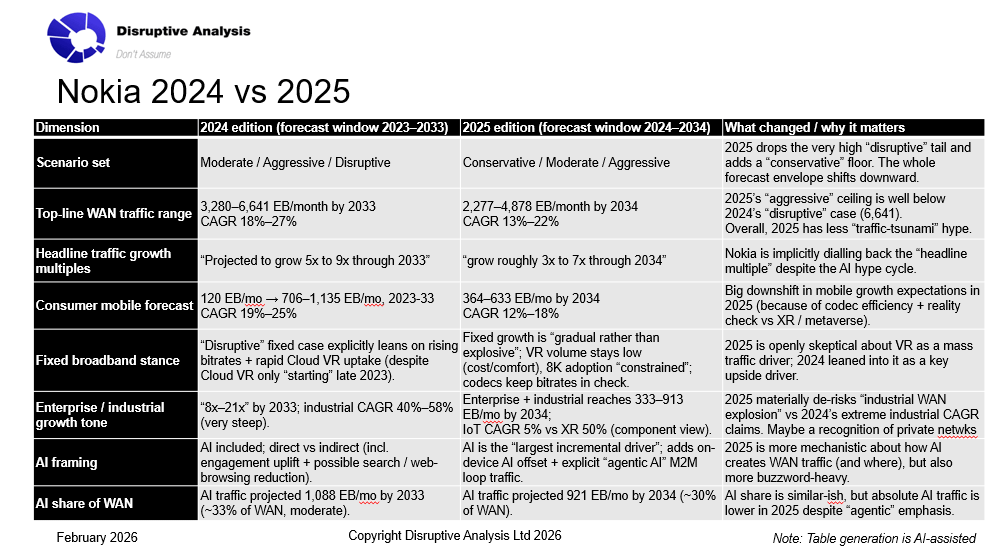
Lastly, it doesn’t make a clear comparison with the previous 2024 forecasts - which would be interesting, as there have been a few changes, especially a ratchet down in mobile broadband growth expectations. Again, that’s understandable - few companies will shine a spotlight on downgraded predictions, but it’s becoming much more transparent in the age of GenAI. I’ve included my own (and ChatGPT’s) analysis below.
Uplink, uplink, uplink…. but really?
Both Nokia’s traffic reports and Ericsson’s recent mobility reports stress that there is going to be much more uplink data traffic - especially human- and IoT-generated video, AI input data from various sources and AR/VR telemetry.
The claim is that there are going to be more “immersive, interactive and uplink-heavy uses”, alongside existing demand from streaming, social media and other traditional applications driving traffic on broadband networks.
At one level that feels intuitively correct. But at the same time, we’ve been doing a lot of other uplink activities in the past - cloud backups, security cameras, two-way voice and video conversations, uploads to social media and user-generated content services, and all the small bits of upstream traffic from website Javascript to gaming controls. Enterprises have uploaded a lot of data and telemetry to the cloud, or again have done network-wide backups and transactions.
That’s all “in the price” today, and so any sudden upward shift in overall mix is going to have to add an awful lot of new high-volume data on top of that (mostly video I think), especially as we’ll also get better compression and various AI optimisations at the same time.
Is AI and ubiquitous analysis of realtime video and streaming data really going to move the dial, especially on public networks? I haven’t seen much unambiguous evidence, except on the local private networks that the report explicitly excludes. I don’t think most connected vehicles send 24x7 video or engine telemetry to the cloud, for instance.
Ironically, one thing that could drive more uplink traffic is if policymakers try to regulate IP interconnect “imbalances”. Streaming companies could just give free security cameras to subscribers and 10TB of cloud storage, or switch to P2P models of content distribution…
If readers have any clear evidence of an uplink explosion, I’d love to see it. But I’m not aware of proof points rather than rhetoric so far. (Separately: regulators should be tracking this, and breaking out uplink vs. downlink in their stats collected from operators, especially if they’re also demanding more spectrum for this specific reason).
Unclear treatment of private and optical traffic
It’s very unclear how the report treats private and dark/leased fibre. If a hyperscaler or datacentre operator wholly or partially owns a multi-Tbps transoceanic fibre, or leases metro-area fibre to connect multiple datacentre campuses or an “availability zone”, is that a “WAN service”?
I suspect that the report is heavily geared towards those WAN connections which are monetised “as a service” by a traditional CSP. But even there, it’s unclear if it includes all data flowing over various NaaS platforms.
The report definitely shows strong growth in enterprise WAN traffic, but I wonder if that actually underestimates the true scale of some data flows, especially for AI training and also general cloud replication and backup.
AI Indirect incremental traffic is very questionable
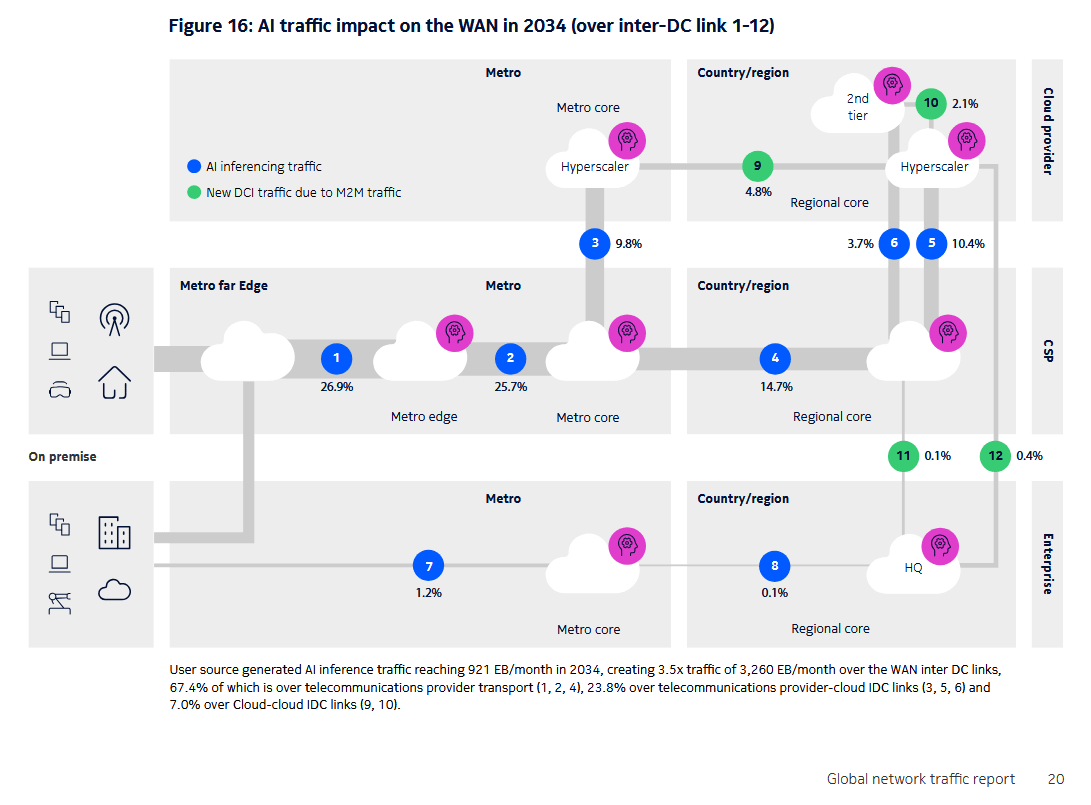
A significant amount of focus in the report relates to extra traffic in non-AI applications, created because AI recommends or steers or otherwise persuades users towards greater adoption and usage. This gets classified as indirect AI incremental traffic.
I see multiple problems here:
Recommendations and curated timelines aren’t new. We’ve had “watch next” YouTube and infinite-scroll TikTok and Facebook for years. They have arguably been AI-based for years. Newer GenAI or evolved versions of deep learning doesn’t really change that, even if the recommendations are a bit better. Anyway, the main traffic impact has come from auto-play, not suggestions.
Demand saturation - people only have so many hours in the day. Just because AI gets better at recommending stuff, it doesn’t mean they’ll watch or consume it. This isn’t a new or AI-specific issue - as long ago as 2017, Netflix’s CEO had already identified their biggest competitor as “sleep”.
AI can also reduce traffic indirectly. It can summarise content, auto-unsubscribe from unwanted newsletters, make backups more efficient and optimise our lives and network use in many other ways we can’t imagine. Agentic AI will do an awful lot of activities “inside the cloud”, and while that may show up in the M2M or enterprise stats, the consumer broadband load might actually fall. Maybe we won’t need to watch videos for fixing home appliances, if our robot works out how to mend the washing machine on its own? [I wrote a post about this, with a Hitchhikers’ Guide to the Galaxy reference]
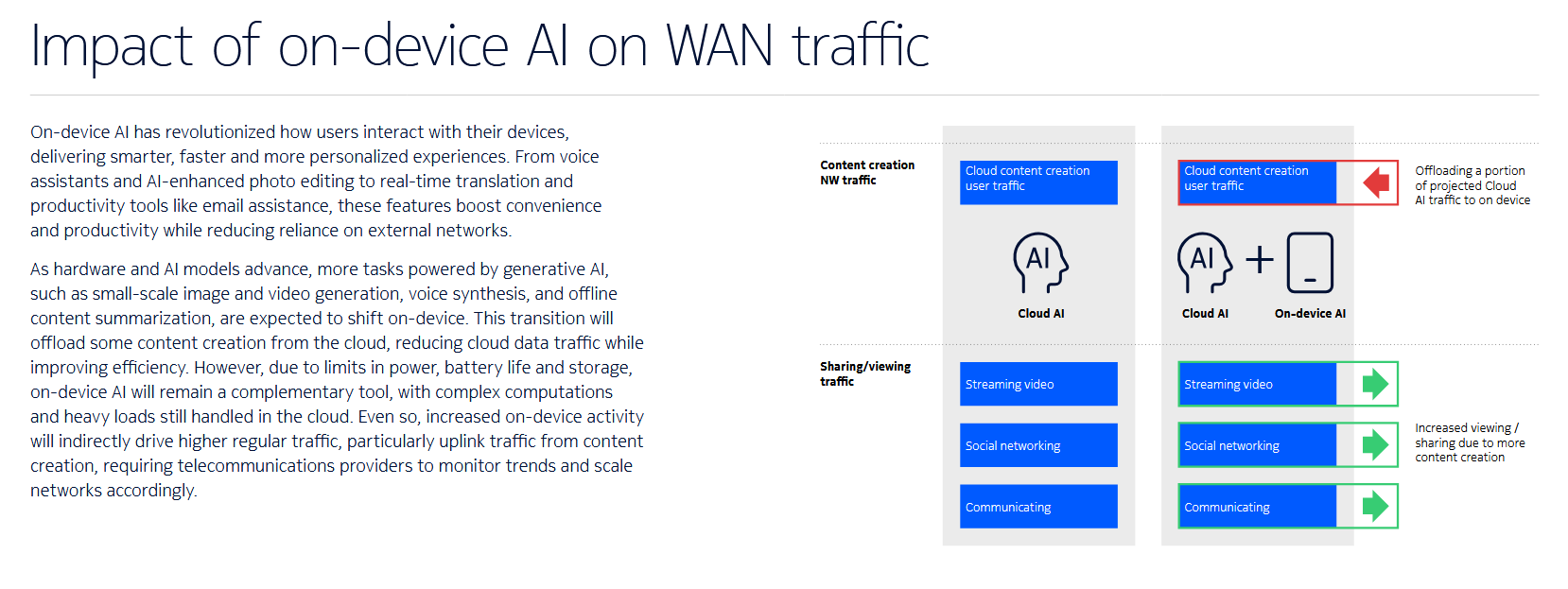
There is ongoing evolution of on-device AI capabilities, for example with recent rumours that Apple is going to push hard with on-device models. While the report does acknowledge that on-device may change the pattern of traffic, it suggests that the positive factors outweigh the negatives. I’m not convinced, although kudos to Nokia for including this analysis.
There’s no “bear case”
While there are a few references to possible dampening factors for traffic, there is no attempt to model a properly contrarian scenario, under which traffic actually falls for various reasons.
I can think of a few factors that could contribute to absolute declines in data volumes:
Wide use of semantic compression or semantic caching
Badly-framed regulation that attempts to tax or otherwise throttle traffic volumes, for instance via spurious links between volumes and energy use
Wide adoption of AI-driven “data efficiency” tools, that go beyond compression, to change the nature of user or application behaviour in using network resources - for instance, using low-latency networks to reduce the need to pre-cache timeline content in apps like TikTok.
Wider use of alternative network mechanisms that don’t look like “WAN services”, such as more use of device-to-device local meshes, satellite connections, optical / laser communications, private enterprise networks and so on.
Use of agentic AI to shift the balance of data traffic from access to DCI/transport. “Watch these 5 videos for me, and compile the edited highlights”
Cloud-based applications or virtual devices, reducing the need for OS / app update downloads.
Low-energy AI chips that can operate on-device or on-prem more effectively, especially for IoT. Sensors with spiking neuromorphic chips may just transmit data when they detect an event or an anomaly, for instance.
Arguably, these types of effects have already occurred - for instance, 800 million people using text-based chatbots, displacing a certain amount of time that would have been spent gaming, watching videos or using AR/VR.
Is it realistic to expect a vendor-issued report to suggest a way we could get traffic “deflation”? Probably not. But it’s something people should bear in mind.
Comparing Nokia’s 2025 predictions vs. 2024 edition
Lastly, I want to highlight what’s changed. This report is not Nokia’s first traffic prediction study. A similar document was published a year earlier, although it’s a little harder to find online.
The chart below compares this year’s analysis with the similar outputs from a year earlier (archived version from another website). Note: I used ChatGPT 5.2 to generate some of the comparisons.
Some headlines:
Downgraded mobile broadband growth forecast, down to 12-18% CAGR, and just 10% and 11% in China and Western Europe under the “moderate” scenario
Actually a slight downgrade in AI traffic volumes in the early 2030s
Wise recognition of limited XR impact (although there’s still some growth expected)
Explicit recognition of codec efficiency
Conclusions
Overall, I think this is a pretty good study, although it lacks some of the detail behind the scenarios and related assertions. It’s acknowledges a lot of realistic factors and trends (on-device AI, agentics, compression, FWA impact) but doesn’t really quantify or justify how they are accounted for.
These are great responses for critics (like me) who’ll ask “ah… but did you think about X Y or Z?”, and it certainly adds confidence that the authors look outside their silos.
I’ll be very curious to see what changes in this year’s edition - and in particular, I’d like to see some hard numbers about uplink vs. downlink, and how and where AI is actually showing up, after another year of both consumer and business use.