Timing is everything: Why telecom industry predictions *still* get it wrong
Revisiting some observations from 2019 - not much has changed, sadly

Background
Almost six years ago, I published an article on LinkedIn (in the days before LI newsletters) about the sources of delay in telecom technology rollouts and monetisation - and how to try to mitigate them.
I think that most of the observations and analysis are still relevant today, so I’m publishing it as a lightly-revised and updated post here on Substack.
Alongside the article, I also recorded an audio podcast explaining my thinking. It’s also still pretty much valid today - you can listen to it here. It’s about 18 minutes long.

Introduction
One of the things I find most frustrating about technology forecasts and visions – especially in telecoms and mobile – is the lack of awareness of adjacent issues and trends, or consideration of "gotchas" and alternative scenarios.
Telcos, vendors and policymakers often try to predict what a new idea might result in. For instance, consider 5G / 6G deployment, network-slicing, network APIs, integrated sensing & comms (ISAC), satellite direct-to-device (D2D) or anything else buzzy and cool. They might list some possible applications, uptake rates, revenue opportunities, addressable market size and so on.
But they often fail to ask two critical questions:
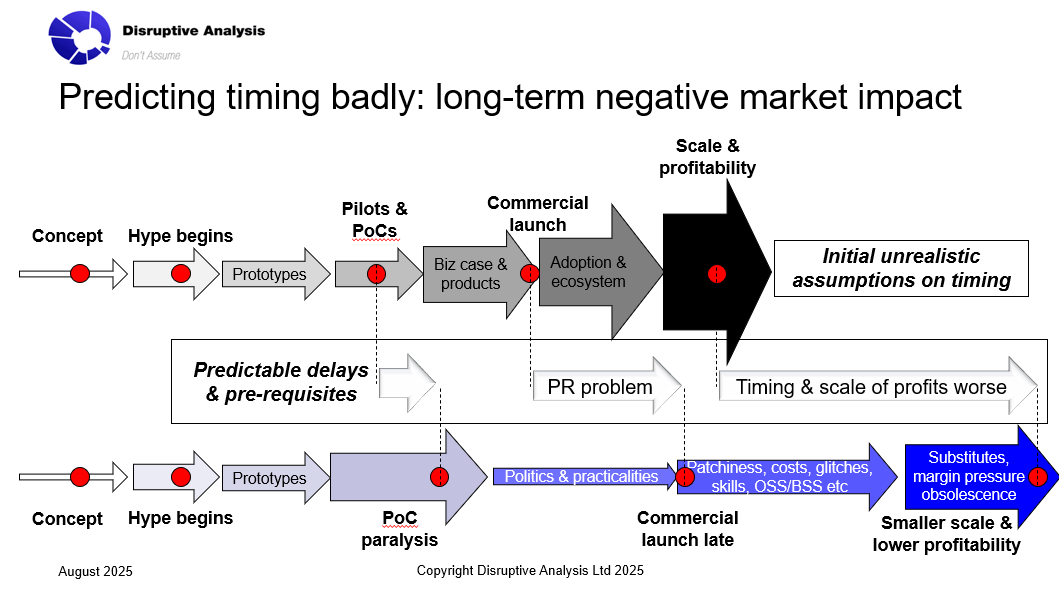
Distractions: What are the prerequisites for this to happen? What are the bits of the overall wider system that are forgotten but necessary, to make the headline technology feasible and useful? And when will they be achieved? What's the weakest link in the chain? Is delay inevitable?
Disruptions: What else is likely to happen in the meantime, which could undermine the assumptions about demand, supply or value-chain structure? What's going on in adjacent or related sectors? What about regulation or geopolitics? What disruptions can be predicted?
Internal distractions & pre-requisites
So for example, in 2019 I noted that “for 5G to be successful to the degree that many predict (“trillions of $ of extra GDP”, millions of extra jobs etc) there first needs to be”.. and then gave a list of pre-requisites.
Let’s review those with the benefit of 6 years’ worth of hindsight
Almost ubiquitous 5G coverage, especially indoors, in sparse rural areas, and in other challenging locations. Verdict: Correct. 5G coverage is still patchy in many places, especially indoors and in remote areas. Even where there’s notional coverage and a 5G icon, often it’s only a thin layer (or 4G + NSA).
Enough fibre or other backhaul connectivity for the cell-sites Verdict: Right at the time, now mostly fixed. This turned out to be one of the easier problems to solve.
Suitable software and hardware platforms to run the virtualised core and other elements Verdict: Correct, and if anything I underestimated - we’re still waiting for 5G SA to be deployed on most MNO networks, and even there it often only covers limited area and subscribers. Some MNOs still don’t see the SA business case, except for niches.
Enough physical sites to put antennas, at low-enough costs & with easy-enough planning. Verdict: Correct, and despite endless rounds of regulatory tweaks to improve planning rules, it can still be hard to get permits and build new sites. Meanwhile, some sites are having to be removed, as landlords find they can make more money from rooftop bars or solar panels, than accommodating cell equipment.
Many more engineers trained and qualified to do all of the above. Verdict: Mostly correct, although the lack of coverage and business case has meant the “skills gap” hasn’t really materialised for many MNOs. However, they struggle when applying 5G to specific verticals or enterprises needing heavy customisation, or niche applications.
A decent business case, for instance in remote areas Verdict: Correct, although maybe satellite D2D might finally help. There’s been some work on government subsidies, but not much on rural neutral-host models.
3GPP release 16 & 17 to be completed, commercialised and deployed, especially for the ultra-low latency & high-reliability applications. Verdict: The standards have been written - indeed, we’re now up to Rel19 and starting work on Rel20. They haven’t been seen commercially, or only for individual features. URLLC in particular is still less common than spotting unicorns in the wild.
Optimisation and operational systems, perhaps based on as-yet-unproven AI. Verdict: Mostly correct, although at least we now have a lot more AI, and there has been a lot of work done on OSS and machine-learning solutions for 5G. Now we’re on to AI-RAN as the next cool thing to watch out for.
We’re almost at the stage where we could make a similar list for 6G, and certainly another list for Network APIs, where hyperbole has been quite astonishing, with forecasts of 100s of billions of dollars of opportunity for telcos selling network exposure functions and related services. It’s one of those areas where you could easily start writing out “gotchas” and find yourself using the word “seventeenthly”.
Yet operators, vendors, industry associations and policymakers often gloss over these "annoying" practicalities. There seems to be an attitude of “oh, they’ll have to make it work somehow”. Well, yes, perhaps they will. But when? And at what cost? What changes does that imply? How will the gaps and limitations be bridged? And what happens if firms go bust while waiting for it all to happen? What other ways to solve problems can users pursue sooner, that don't involve 5G / APIs / mobile edge compute / satellite / pick-your-favourite-overhype?
A key implication of this is that timing and profitability of massmarket adoption is often much later than expected. While Amara's Law might eventually apply (we tend to overestimate the effect of a technology in the short run and underestimate the effect in the long term), that doesn't mean that early initial adopters and investors make the returns they'd hoped for.
External disruptions and substitutes
Perhaps even more pernicious is the lack of situational awareness about parallel developments elsewhere in the broader tech ecosystem. These undermine both demand (as alternative solutions become viable in place of the hoped-for technology) and supply / operation (by throwing up new complexities and gotchas to deal with).
These are often not just “what ifs" but “highly likelies” or "dead-on certainties".
So for instance, the original 2019 visions of network slicing, or edge-computing for 5G, even when presented as forecasts at the time, should have imagined a realistic and plausible future world.
I’ve left these bullet points unchanged from the original versions I wrote 6 years ago. Read it through today’s lens, and then realise that all the rosy forecasts of that era didn’t bother to stress-test against all these predictable (and predicted) scenarios:
5G networks are still patchy. There will still be lots of 4G, 3G and “no G” locations. What happens at the boundaries, and how can you sell QoS only in certain places?
There will be a patchwork of “uncontrolled” locations – they might be 5G, but they could be owned by roaming partners, indoor network providers, private localised cellular operators and so on. How will a slice work on a neutral-host's network?
An ever-greater number of devices spend an ever-greater amount of time on Wi-Fi – usually connected to someone else’s fixed-line infrastructure and acting as either uncontrolled, or a direct arbitrage path.
Telcos have to cap their energy use and associated CO2 emissions, or source/generate clean power of their own.
Wi-Fi 6 will emerge rapidly & is hugely improved for many use-cases, but most 5G predictions only compare against legacy versions
Hardware based on "commodity hardware" runs against the current tide of semiconductor fragmentation and specialisation (see recent post, here)
Devices will often have VPN connections, or use encryption and obfuscation techniques, which means the network won't be able to infer applications or control traffiic.
Users and devices will use multiple connections together, either for arbitrage, aggregation, or more-sophisticated SD-WAN type models.
Pricing, billing, customer support and security will be challenging on "federated" 5G or edge-compute networks. Who do you call when your network-slice doesn't deliver as expected - and how can they diagnose and fix the problem?
Liability and accountability will become huge issues, especially if 5G or slicing is used for business-critical or life-critical functions. Are your lawyers and insurers prepared?
AI will be used for instant price-comparison, quality monitoring & fault reporting, collective purchasing and even contractual negotiations. "Hey, Siri, mimic my voice and get me the best discount possible with the customer-retention agents"
Most of these scenarios can be lightly updated for any new predictions made today. Obviously we can also add in a bunch of others about GenAI, geopolitics and wider adoption of fibre everywhere as well.
These are just some basic examples. Once you get into individual verticals, particular geographies or even specific companies, a whole host of other issues start to crop up - sector regulation, value-chain shifts, government involvement, expectations of 20-30 year tech cycles and so on. Sure, in theory 5G / 6G - or today’s network APIs - might fit into various industries' own transformation journeys - but they won't design around it.
Conclusions
I find this all very frustrating. So many company boards, strategy departments or lower-level product/service management teams seem to operate on the basis of "all other things being equal..." when the one certainty is that they won't be.
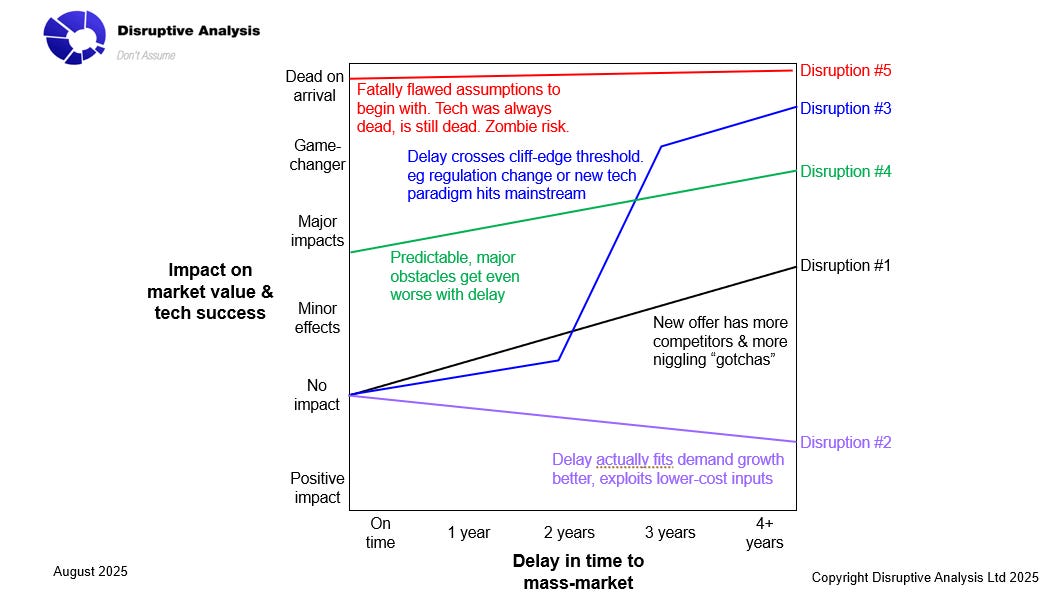
So the two sets of factors tend to be multiplicative:
Distractions are internal to a new concept, and lead to delays in technology launch, market maturity and revenue.
Disruptions are external and often inevitable, but any extra delay increases their range and impact yet further.
It's never possible to predict everything that might get delayed, or every possible disruption from adjacency. But it seems to me that many companies in telecoms don't even bother to try.
Companies accept the famous "hype cycle" as inevitable, even if it might be possible to flatten it out.
By coincidence, while writing the original version this post I started reading "Range" by David Epstein (link) which talks about the importance of "analogising widely", and the risks of narrow expertise and superficial analysis, rather than looking for implications of cross-sector / cross-discipline similarities and lessons. It’s still a good read - and I’d also nowadays recommend “The Geek Way” by Andrew McAfee and a few others.
When evaluating new technologies and service concepts, CEOs and CFOs need to rely less on familiar industry echo-chambers and consensus hype, and instead seek out critics who can find hidden assumptions, both internal and external to their plans. This isn't just a negative exercise either - often, a "ranging" exercise throws up unexpected positives and opportunities from adjacency as well risks.
If I look around the tech and telecoms sector at the moment, I still see the same overhype and over-expectation, without consideration of complexities, distractions and disruptions.
2025 seems very similar to 2019, only instead of 5G we’re hyping 5G Advanced and starting to ramp up 6G visions. I’ve already mentioned the Network API breathlessness.
And instead of edge computing, all the talk now is about edge inferencing for AI, again putting telcos in a starring role, rather than the more realistic position as supporting cast, or maybe just as a walk-on extra.
There’s a growing list of external disruptions too - trade policy, geopolitics, AI undermining business models while accelerating others, cybersecurity risks and much more.
My long-term vision and aspiration is still to “flatten the hype cycle”. But it’s remarkably resilient. Maybe my own timing for the 2019 article got it wrong, after all.
Footnotes
The original accompanying audio podcast explaining my thinking is still pretty much valid today - you can listen to it here. I should maybe start doing that format again.
I sometimes get asked to "stress test" ideas and plans, and help companies avoid expensive mistakes, get started on future glitches today, or prepare for and avoid contingencies and unintended consequences.
Often, that exercise will throw up new opportunities as well. Usually, a collaborative (but candid) group workshop ensures this isn't a blame-game, but a path to smoother growth and innovation. The skills and mindsets can be learned and replicated, too.
If that type of approach sounds interesting, please get in touch with me, either by email (information AT disruptive-analysis DOT com) or via LinkedIn.